
When Shell announced in August 2025 that it would dismantle more than 2,000 Volta charging stations, it sent a clear message: free, ad-supported EV charging may look good on paper, but it rarely pays for itself. The U.S. experiment exposed the challenge of merging utility-scale infrastructure with media-driven revenue models.
Into that breach steps Jolt Charge, an Australian firm bringing a hybrid approach to North America. Jolt recently announced the acquisition of Volta’s U.S. assets, while in Canada a 5,000-location rollout has been underway for the past year.
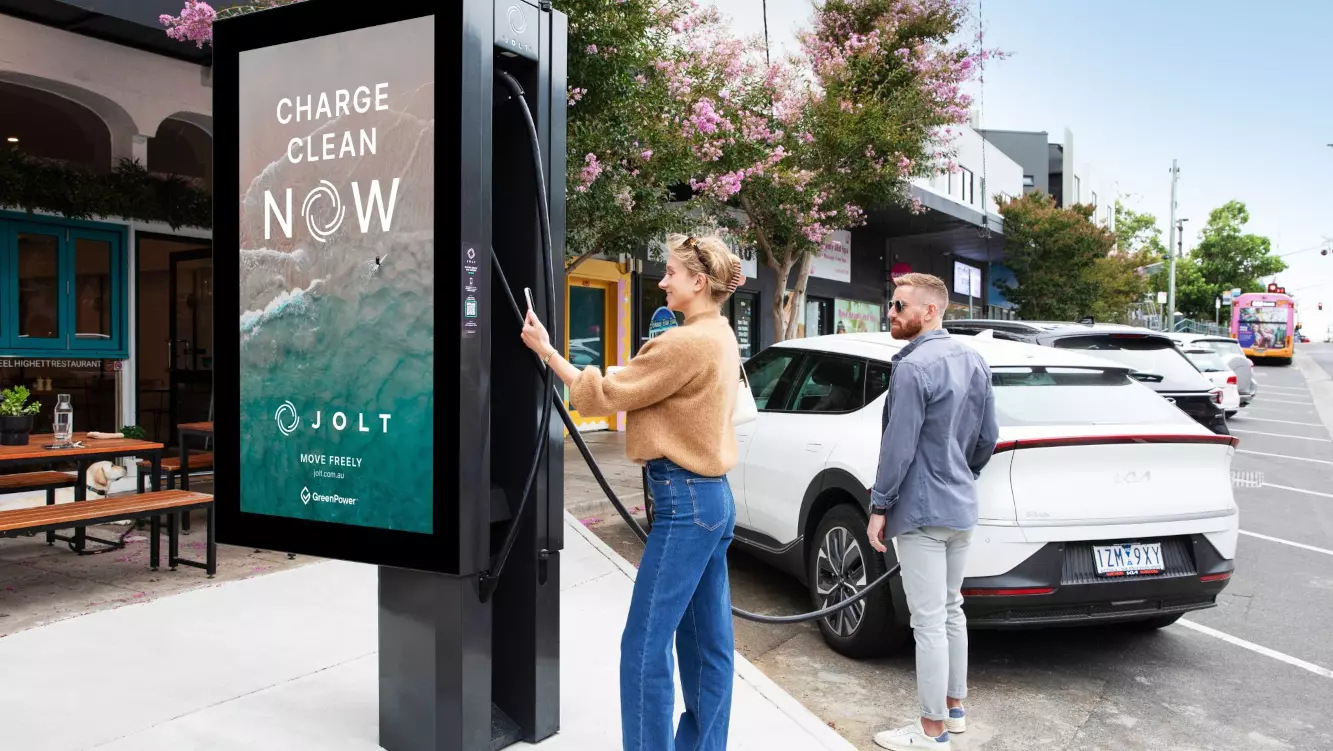
Jolt’s business model gives drivers a small daily allowance of free charging and lets them pay for any additional energy. Each charger includes a digital-out-of-home (DooH) display, monetized through programmatic advertising. In the U.S., the question is whether Jolt can turn Volta’s former network into a sustainable business. In Canada, the rollout serves as a high-stakes test of whether the EV-charging-plus-media model can succeed at scale.
Charging growth meets geographic gaps
According to a March 2025 report, Canada had about 12,955 public charging locations offering 33,767 ports nationwide. That’s a 24 percent year-over-year increase, but most are clustered in Ontario, Quebec, and British Columbia, leaving other regions underserved.
Yet, as one industry observer put it: “I wish them luck but the history for companies that start capital and operating expense-intensive DooH media networks is not great.”
Jolt’s expansion in the greater Toronto area
Jolt launched in the Greater Toronto Area — Canada’s largest metro region, home to about 7.5 million people — with its first curb-side charger in Richmond Hill, Ontario. Each unit offers 7 kWh of free energy (roughly 40–50 km of range) before switching to paid use. The company plans a 5,000-charger national network by 2043, each paired with ad-enabled screens. In February 2025, Jolt secured a C$194 million investment from the Canada Infrastructure Bank to fund up to 1,500 new curb-side chargers in urban centers.
Jolt CEO Doug McNamee positions the model this way: “We’re not just focused on charging, we’re focused on what happens around it … a platform where smart mobility meets smart media.”
Learning from Volta’s missteps
Volta’s downfall rested largely on its “free charging funded by advertising” model. While the concept attracted drivers, the ad revenues and utilization didn’t scale as hoped. In Canada, Sixteen:Nine’s Dave Haynes cautioned: “This looks more like a discount, and if motorists make the effort to stop and plug in … they’re probably going to keep charging once the free kilowatt hours are used up.”
In the same article, Haynes noted that high-quality outdoor-rated LCD screens cost a premium, electricity rates vary widely, and suburban charger sites may deliver only modest foot traffic impressions for advertisers. “It’s not 1,000s on busy downtown sidewalks,” he writes. Thus, Jolt’s hybrid model attempts to shift the risk from charging ad revenue alone to charging a combination of ad revenue and revenue from charging.
EV adoption slows as policy momentum shifts
The Canadian EV market shows promise — but with caveats. In 2023, zero-emission vehicles accounted for roughly 11.7 percent of new light-duty sales. That’s a meaningful step up from 2022, but still shy of the 20 percent milestone set for 2026.
At the same time, policy and public attention have shifted. Under former Prime Minister Justin Trudeau, the messaging was high-visibility; under the current leadership with Mark Carney in office, the tone has been more fiscally pragmatic and less headline-driven. A July 2025 article by the North Shore News noted that “Canada continues to fall behind on building up EV-charging network” even as EV sales rise.
DooH as a catalyst and turning dwell time into monetization
From a media standpoint, EV charging offers valuable “dwell-time” exposure: drivers are parked, engaged, and reachable. For cities, ad-supported chargers provide visible green credentials and potential cost offsets.
Still, success depends on execution. Content quality, audience analytics, ad pricing, and utilization must align for the model to work. What succeeds in Toronto, Vancouver, or Montreal may not translate nationally, where lower density limits both charger use and ad reach.
A test case for Canada’s smart infrastructure future
Jolt’s rollout could show how infrastructure investment, media monetization, and commercial viability intersect. If it works, Canada may become a showcase for self-sustaining EV networks that blend clean energy with data-driven advertising.
If it fails, the lesson will echo Volta’s: even strong technology and good intentions can’t overcome weak economics. Either way, this is more than a story about chargers — it’s about how Canada’s next wave of infrastructure could merge power, data, and storytelling in the public realm.
(Image: Jolt)