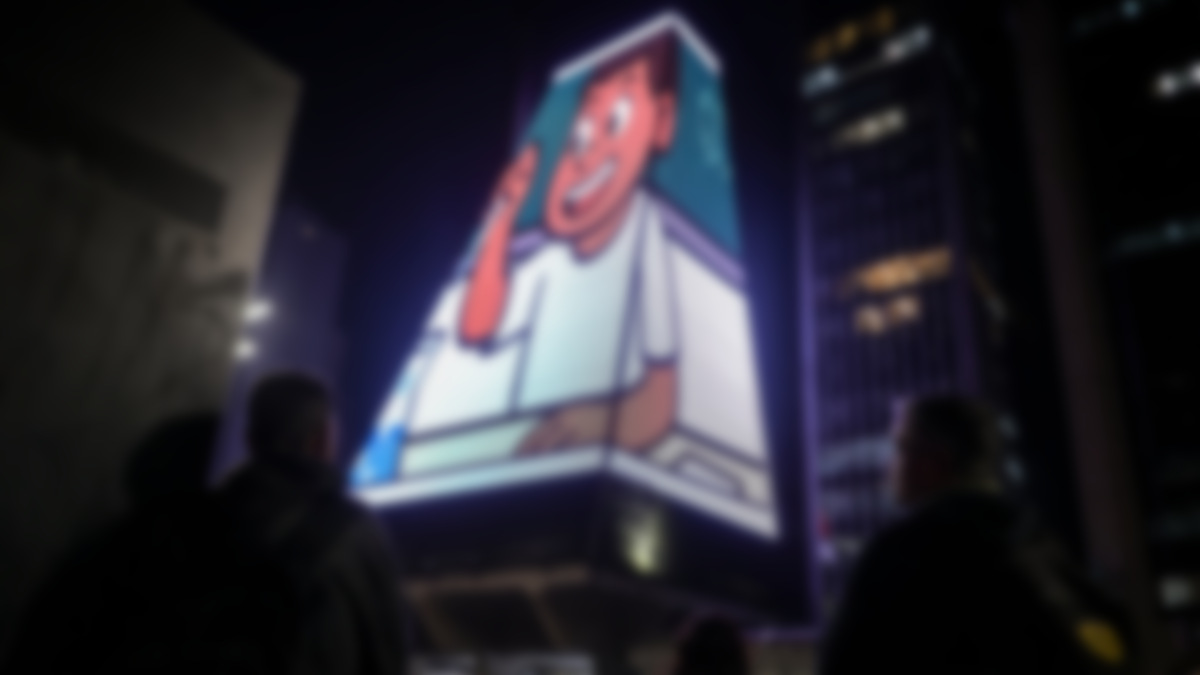
What’s framed as “Latin America’s largest open-air digital art gallery” has just undergone a major tech upgrade. The original setup – a low-res LED light façade spanning 2,818 m² (303,323 ft²) – was installed in 2012. Now, the screen wrapping the triangular Fiesp building in São Paulo boasts four times the number of LED dots and ten times the brightness.
When it launched, the screen was a bold digital art experiment. The Fiesp building had been established as a venue for exhibitions and festivals, hosting artists from around the world who created original work specifically for the digital façade. Thirteen years seems like a reasonable lifespan for a screen like this, making a retrofit timely – especially with LED technology becoming cheaper and more energy-efficient.
AV integrator ON, with offices in Portugal and Brazil, handled the original installation and was chosen again for the upgrade in a public tender. The 26,000 original LED dots were swapped out for over 120,000 custom-engineered units. The display now reaches a peak brightness of 471 cd/m² (up from 45) and a resolution of 480 x 322 (up from 221 x 170). Color capacity has expanded from 68 billion to over 281 trillion possible shades through 16-bit RGB processing.
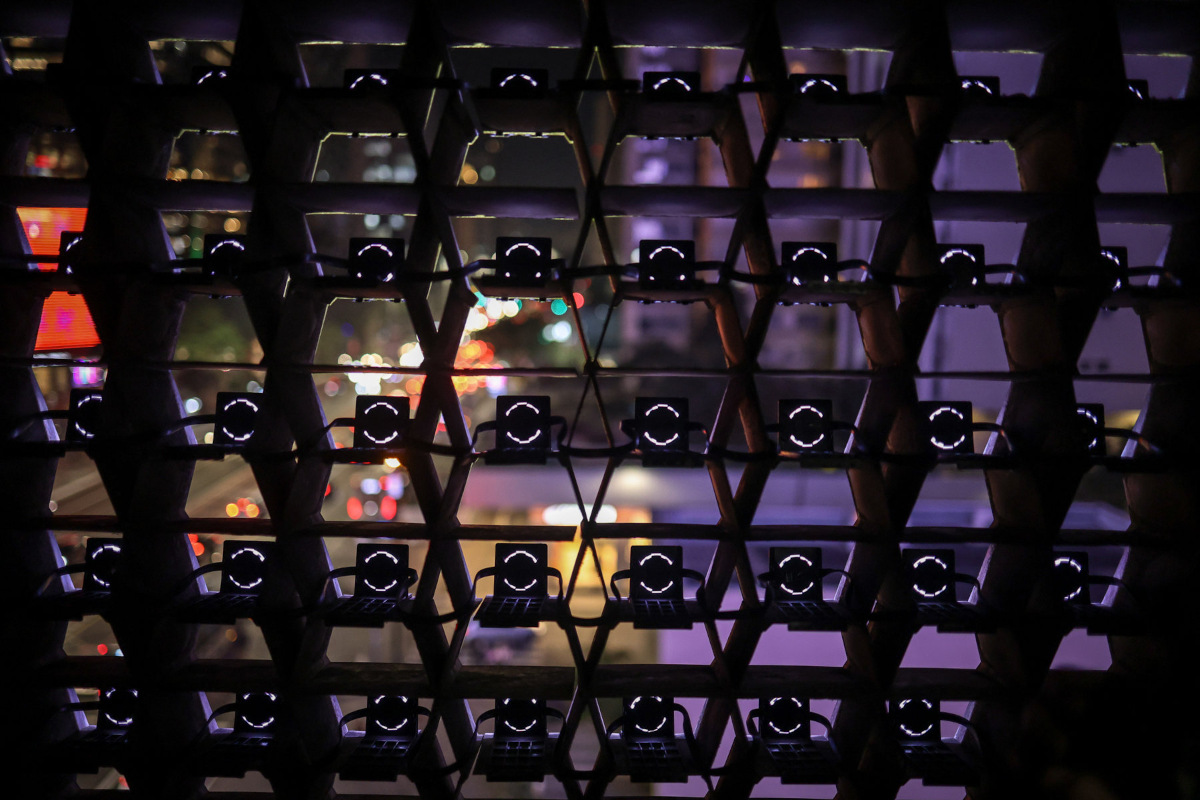
The dots are grouped into weather-sealed units of 40, a design choice that protects against oxidation and wear – key in São Paulo’s humid subtropical climate.
Apart from hand-installing each of the LED dots, the toughest part of the job, according to ON, was developing a custom pixel mapping system to match the building’s unusual geometry. “We had to teach the building how to ‘read’ the video data in a new way,” said Hugo Rodrigues, CEO of ON. “Now, each control box understands its exact starting point, which enables pixel-perfect alignment with the architecture.”
Content is delivered through a centralized controller capable of receiving real-time video inputs via HDMI, DVI, or DisplayPort. These are converted into DMX protocol signals for precise playback.
To make the platform more accessible for creators, ON also built a simplified pixel map that integrates with common visual design software, allowing artists to preview their work before it goes live.
The system’s total maximum power consumption is 259.72 kW (at 85% efficiency), with up to 14 hours of daily operation. As part of a five-year maintenance agreement, ON provides biweekly preventive maintenance of the system.
You are currently viewing a placeholder content from Vimeo. To access the actual content, click the button below. Please note that doing so will share data with third-party providers.