
Guest Post: Ross Noonan, LED Studio
 Let’s clear up some of the confusion, once and for all, around microLED.
The true definition of microLED can vary depending on who you ask, leading to industry confusion and the false claims. Let’s clarify this debate with some clear facts.
MicroLED, miniLED, and standard LED are defined by the size of the individual red, green, and blue diodes that make up a pixel. These diodes can be very small, measured in micrometers (µm), also known as microns. LEDs with RGB diodes larger than 200 µm qualify as standard LED, anything between 101 and 200 µm is considered miniLED, and anything equal to, or smaller than 100 µm is classified as microLED.
So Why All The Confusion?
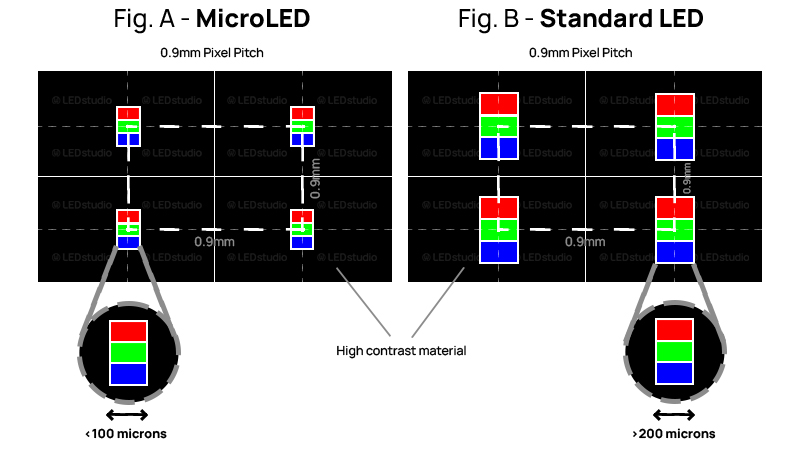
Confusion mainly stems from resolution and pixel pitch. Many manufacturers claim that any product with a sub-1mm pixel pitch, or one that uses COB technology with options for sub-1mm pixel pitch, must be microLED. But standard LED technologies like (SMD) and miniLED can also achieve pixel pitches below 1mm, and that doesn’t make them microLED.
Here’s a diagram showing how standard LED and MicroLED of the same pitch look. Note that although they have the same pitch, one uses microLED:
But Surely MicroLED Means Higher Resolution?
Now that we understand microLED refers to the size of the diodes and not the pixel pitch, we can appreciate that true microLED technology allows for much tighter pixel pitches of less than 0.9mm. Smaller RGB diodes mean smaller pixels, which means you can fit more pixels into a given area.
With standard LED, the highest pixel density typically available on an LED module is a 0.9mm pixel pitch—the distance from the centre of one LED pixel to the centre of the next. It becomes challenging to position pixels closer together while maintaining display quality, due to the physical size of the diodes.
So In Theory, Could We See MicroLED in Pixel Pitches Greater Than 1mm?
In short, yes, especially as they get brighter in their output. However, at the moment, brightness is their limiting factor. As MicroLED technology evolves, it may be used in wider pixel pitch displays. But why?
One key benefit is contrast. The smaller the diodes, the more surface area of the display can be made with high-contrast materials, resulting in a much higher quality display in terms of visual clarity.
The Future Of MicroLED Technology
In summary, understanding the true definition of MicroLED—based on the size of the diodes rather than the pixel pitch—helps to clear up much of the confusion in the industry. MicroLED technology, with its smaller RGB diodes, allows for much tighter pixel pitches and higher pixel densities, providing superior resolution and clarity.
While standard LED technology has its limitations in achieving higher pixel densities, MicroLED opens the door to new possibilities. As this technology continues to evolve, we may see microLEDs being used in larger pixel pitch displays, offering significant benefits in terms of energy efficiency and contrast. This advancement will undoubtedly lead to even higher quality displays, enhancing the viewing experience with more detailed and vibrant visuals.
ABOUT THE WRITER
Ross Noonan is the Technical Sales & Global Marketing Manager for LED Studio, a UK-based turnkey solution provider and manufacturer of indoor and outdoor LED displays for commercial, corporate, retail, rental, sports, stadia and digital signage applications. LED is fast becoming the display technology of choice for many sectors. LED Studio assists in the design, delivery, integration, content creation and ongoing support of LED projects all over the world.