In the fall of 2008, just as the recession really started to reveal itself on the markets and elsewhere, Philadelphia was host to Digital Signage Expo East.
Foot traffic would be politely described as modest. It was pretty much a ghost town. The story was 900 people in all, but that was doubted.
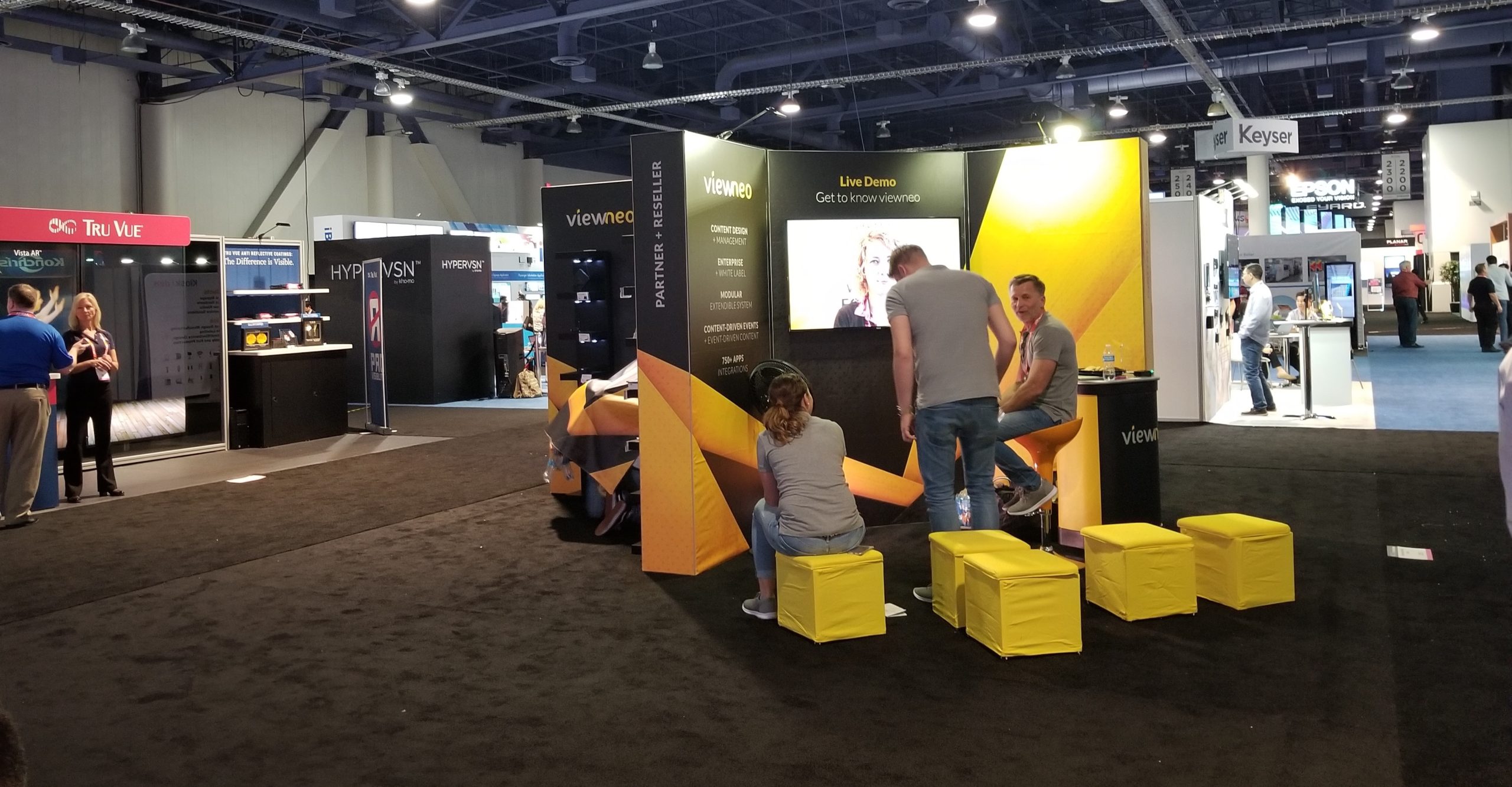
There’s no way to sugar-coat it, but that’s a bit like how it felt on Day Two of DSE this year. Certainly, it was not a ghost town. But just as certainly, there’s no way it could be described as busy.
I got there around 9:30, a half-hour ahead of opening, and was struck by how few people were hanging around waiting for the doors to open up. I looked around inside at 10:30 and thought, “Man, where is everyone?”
Maybe, I thought, a lot of people got their Vegas on the night before and were just waking up back at hotels.
I grabbed food downstairs at 1 pm and there was one guy ahead of me in the lone checkout open in the food court.
The very large Scala and sister companies booth at the front, by 2 pm, was empty of anyone but the people who were supposed to be there. Lots of people I know who are normally chained to their company stands all day were sitting around in lounges chatting and flipping through their smartphones.
At another large-ish stand near the front, the majority of the team was sitting on the couches, bored silly. One legendarily cranky New Yorker gave me 10 salty minutes on why the whole thing was pointless.
Now, to be fair, there definitely were attendees in the aisles, and I spoke with some companies who felt 2018, overall, was better than 2017. Jeff Hastings and Ann Holland from BrightSign said the show was huge for them, and had not really slowed at the stand until mid-afternoon on day 2, which is normal.
Maybe the attendance numbers, when released, will tell a different story. But if they do, they will be greeted by some serious “Hmmmmms …”
What went wrong, if something did? I dunno. I just “Go” to trade shows, I don’t plan or run them.
Here’s what I do know. In general terms, trade shows are a bit old-fashioned in the age of instant communications, distance learning, video everywhere and so on.
They also cost a fortune for exhibitors.
I also can’t help but think at least some people are choosing, instead to go to other shows. ISE grew by something like 16,000 attendees this year. DSE will not likely be more than 5,000 attendees, if that, in total.
The highly regarded ShopTalk retail conference was just on in Vegas a week earlier, and Globalshop was on this week in Chicago. Retail is certainly not the only vertical targeted for attendees, but it’s a biggee. ShopTalk flies in and puts qualified retailers and brands for the event, with those people agreeing to spend a couple of hours in speed-dating sessions with matched-up vendors. It works and the thing is growing.
It was also spring break for a lot of schools, and heading into a long weekend (Easter).
The Exponation people who run DSE work really, really hard to put on a smoothly run, polished, generally good looking show. The back 40 can tend to look a bit shabby, but that owes a lot to exhibitor budgets that don’t extend much beyond renting a table and stools.
They also work really hard to deliver qualified end-users on the show floor. Maybe they did that, at least for some exhibitors. The general attitude is quality is important, not quantity. 50 great leads beats 500 people wandering in with no real mission, looking for jobs or doing competitor research.
It is a very effective, efficient show for vendors and integrators to collaborate, and for existing clients to come in and see updates on what’s new. But the main game is lead-generation.
So … all that stated, here are some impressions on what I saw walking around.
The most interesting thing was something I’ve now seen three times, but each time got more information on what all is going on with it. A Shenzhen LED manufacturer, CreateLED, has fine pitch display modules that have a thin film coating on them that protects the LEDs. It is described as a cured adhesive layer.
Using this, the LEDs can be exposed to the general public in environments like airport and retail concourses, and elevator lobbies, and not be immediately damaged if bumped. The LED “packages” on conventional surface-mounted LED displays, are fragile and brittle, and if you look closely, you can see particularly at the edges how those packages get damaged.
Create has developed tech that adds this “cured adhesive layer,” but still allows the heat building up from the LEDs to bleed off. It also has low reflection properties and is humidity proof.
I saw the tech, now dubbed Ebony, being used on a 1.2mm pitch display, and it looked really good.
The hitch on this is cost. This tech, at this pitch, was $35,000 a sq. meter. So a sizeable video wall would have a lot of zeroes in the total cost, and this is not something that will be showing up in your regional airport anytime soon.
But it is the future of LED, I think, because it will mean the people who design public, corporate and retail spaces to add active, reasonably rugged LED displays to the consideration set for wall coverings. Marble? Tile? Maple? Or active, changeable digital?
CreateLED is NOT the only company with this. I saw two others at ISE and there’s no doubt others have product in development.
Also interesting around the show floor:
Four color E-Ink displays, in large formats – The tech is still being refined and the things kinda freak out for about 10 seconds as they change visuals. But when they build and lock in they are pretty nice. No light means the color saturation is nothing like an OLED or QLED, but as a poster replacement, not bad. Podcast coming on this.
Gable, up at the front, had an interest demo of thin cement boards that allowed light to pass through, with that light coming from a hidden P6 pitch LED wall. They used IR sensors to track the motion of a device and emulate a spray can doing graffiti on the wall. Kinda cool for a setting like a children’s museum or maybe a club.
A UK company called Ultrahaptics was showing tech that uses ultrasound to create the sensation of touch in mid-air, using a Leap Motion as the tracker, in front of displays. They were demo-ing what that looks like for things like an active movie poster. Not totally sold on it, but the company is testing a new vertical, with the core focus being automotive (car touch screens drivers can “feel” they are using while keeping their eyes on the road).
BrightSign, which is partnering like crazy now with hardware and software guys, has a meeting room sign product now, with a player inside.
Jeremy from Screenfeed showed the early versions of a Slack integration they are field-testing. It is interactive and goes well beyond just being a “channel” showing posts.
Tons of other little things around the how, at various stands, that were brighter, slimmer, lighter, more durable and so on. As said in the past, this is not an industry seeing huge breakthroughs, but rather steady, incremental improvements and enhancements.
On my way home today. I enjoyed the show and always get value from it. I certainly hope there was enough in 2018 to make 2019 viable. I don’t want to go on and on about this, but Day 2 was a little disturbing.