Google‘s Vidya Nagarajan was our first speaker last week at DSrupted, taking attendees though the tech giant’s vision of cloud services and how it plugs in to digital signage.
I barely sat down on the day, and never had time to take notes, but I did listen and did get a copy of her presentation deck – which I’ll make available to attendees this week.
Here’s a sense of what she said …
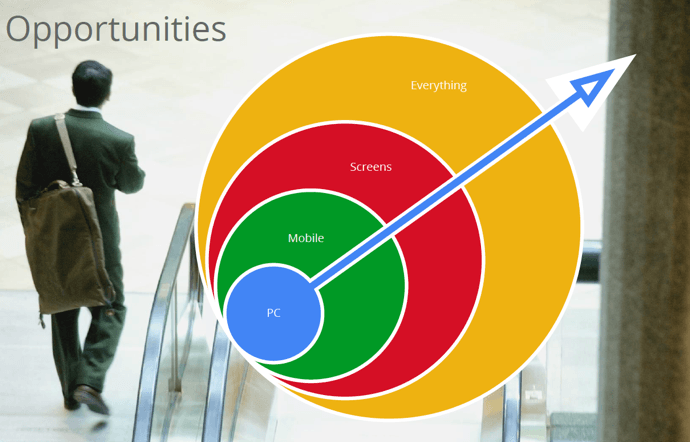
At a macro level, the company believes it’s only a matter of time before most signs are digital, their functionality suiting the need. Google sees signs as the evolution of driving desktops, then mobile, then screens, then everything.
The trends driving this are:
- Google as a company has gone way beyond its early days of Gmail as its cloud service. Now there’s a growing suite.
- What Google calls cloud catalysts are much stronger now – consumers are familiar and comfortable with cloud services
- Use of Cloud services by businesses has ticked up in a big way, with more than 5 million business using Google apps, including more and more very large enterprise companies like the retailer Woolworths
- Enterprises are starting to understand their business information may be as safe or safer in the cloud than it is on premise
Google argues Chrome is ideal platform to drive all this, for several reasons:
- Hardware-level security, with a verified boot that does in Blue Screens of Death
- Cloud level virus and malware protection
- Central deployment and management
- Steady revisions and improvements
- Reliable boxes that easily load and boot up in eight seconds
Nagarajan said the company sees more of a future for digital signage done with Chrome than with Android, and that it makes more sense for the developer community. With Android, software companies have to deal with and worry about changes to the operating system. Using Chrome, developers just need to focus on the functionality and relevance of the app that sits on top of the OS that Google worries about and manages. She pointed out that Google has 10,000 developers it can put on Chrome.
Makes sense. Android is a moving target in terms of versions and stability, and as noted earlier, a few people have said Android 4.4, aka Kit Kat, is the one that’s stable for DS. Many or most of the Android boxes I’m aware of pre-date 4.4, and I’m not sure if they can be upgraded. That said, I think the companies that have been most serious about Android have a solid grip on what their units will do and the operating system driving them.
It also means this is NOT just a play for signage software companies who want use Chrome as a platform. Nagarajan referenced several times how the company is talking to content providers who are interested in putting an app on top of Chrome. So you could have a company that presents specific content in interesting ways – let’s say visualized energy management data – drop an app version of its presentation on Chrome, and sell a digital signage product without getting into any of the CMS stuff.
Nagarajan, who is based in Mountain View (head office), talked a lot about constant evolution of the product and how that’s reflected in periodic updates that improve the hardware being used.
The company is doing quite a bit of work with Rise Vision, the Toronto-based company that caused a lot of head-scratching a few years ago when it went to a free model (with premium services) and built the whole thing on the Google cloud. Without giving away secrets, I know the early bet made and the ties that were established and nurtured are now paying off for Rise.
Digital signage is likely a teeny piece of business, in relative terms, for Google, but the presentation and some other things happening now have me convinced the company is doing more than dabbling in the business. The company doesn’t talk much about where it’s going with things, but I still think if they get enough Chromeboxes out there running off a centrally managed system, that’s another distribution system for Google AdSense display ads.
And turning that on would be dead-easy, as it’s already built.