
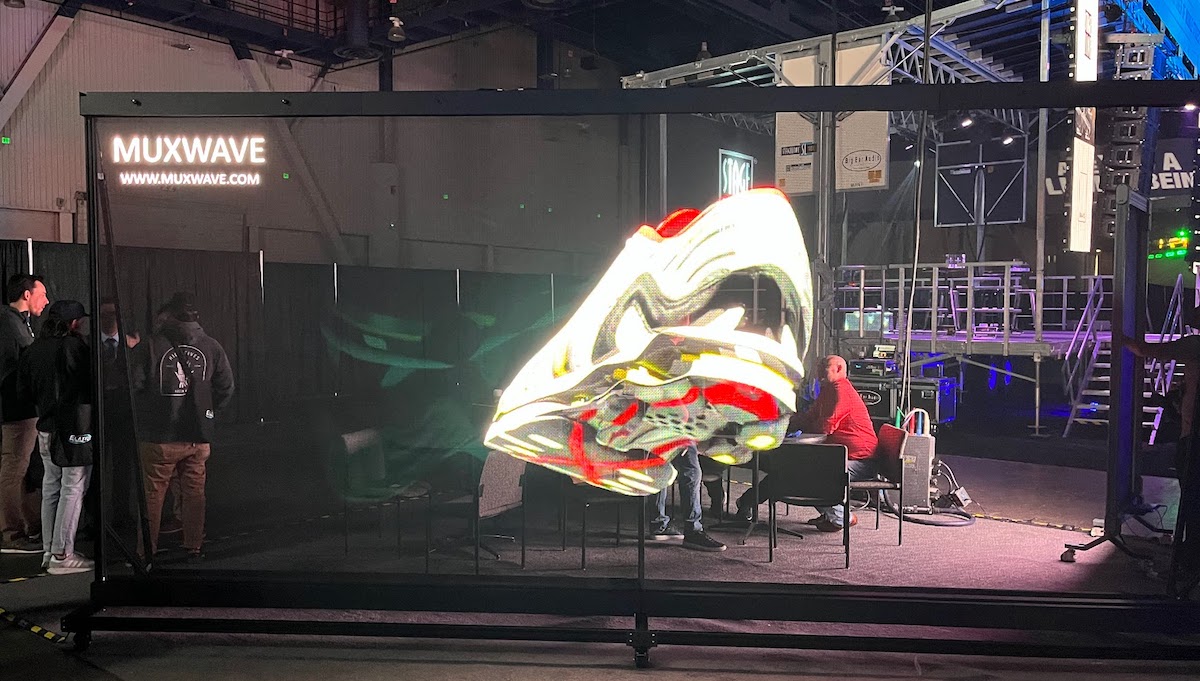
Way, way in a back corner of the LDI live events technology show – which was running at the same time as DSE last week in Las Vegas – a Shenzhen company called Muxwave was showcasing what it called a transparent LED video wall product.
It wasn’t transparent, but it was at least as transparent as the better-made mesh LED displays on the market. It also wasn’t a hologram, as it suggested … joining the seemingly endless list of display manufacturers calling their products holograms or holographic when they’re not (listen to this podcast …).
It was, however, quite interesting. The other semi-transparent products being marketed these days have a series of horizontal bars that hold the little light emitters and deliver power and signal. They are grids, and noticeable from the rear end. Muxwave doesn’t do that. It has wafer-thin fibreglass strips that hold the LEDs, with circles between each of the LED packages. It is reminiscent of bug screens on residential windows and also looks like a variation on the vinyl wraps you may have sometimes seen on commuter trains and buses – with a series of holes enabling riders to still see out the windows that are covered in the wrap, while the outside view likes the bus or rail car is covered with a moving billboard.
The result is super-thin, very lightweight displays intended for display jobs like mall windows. They are not almost fully transparent like LED on film, such as LG’s product, but they have a tighter pitch and, I gather, they cost way less. In reviewing some of the photos I took, from the rear – when it is on – the rear side does seem very much transparent, but that was in an expo hall that was purposefully dark so that other exhibitors could demo things like specialized lighting and fog machines. When it is off, you see the substrate or whatever you want to call it.
Muxwave describes its product this way:
Muxwave redefines transparent LED with game-changing LED chip & IC integration technology, vertically and horizontally symmetrical P3.91 mm pixel pitch, static scan, and keel-less module design for sharper visual treatment at true 16 bit grayscale performance.
Beats me what some of means, but it is genuinely quite different from competing products. The gray LED wafers are interconnected by very thin patches you have to squint to see, and the patches are not evident from the front. The LED wafers are just 2mm thick and can attached to glass and covered in a film, I understand, or suspended, as they’re not at all heavy. They can be mounted “without a dragon skeleton” (I have no idea what that is), and one unit can be as wide or tall as 2.4 to 3 meters.
Like other transparent LED products, transparency hinges a lot on pitch – with a 6.25mm having 80% while the 3.9mm has 90% transparency.
An industry friend from Toronto – who has used LED window film in retail settings – encouraged me to go over and have a look. He was very excited by it. I was mostly ambivalent when I first saw it, but warmed to it as a good alternative to finer pitch mesh products or LED film that isn’t yet at the kind of pitch. Film also worries ops people, who think as much or more about durability and serviceability, as they do about the transparency rating. Will the film peel or grow discolored with time because of UV light and heat?
I wrote about these guys in September, based on some Linkedin videos that some commenters suggested were CGI fakes. I have seen it up close now and it was same content, not faked.
The company was a little challenged, as is too often the case, by staffing a US show with people who don’t have the best command of English. Why turn up at a show if there is going to be a persistent language gap? So I didn’t ask many questions and didn’t get much from lurking when others were asking about how they went up, their ruggedness and so on.
Whatever the case, it was interesting to see, and indicative of how LED displays can be super-light and are getting to the point that they are architectural design materials, built into windows and suspended from structures without a lot of engineering.
By comparison, here are a couple of other variations on transparent mesh LED. The first is what you see from the rear of an outside-facing window screen at an Olive Garden on the LV Strip. It was quite good.
The second is a semi-transparent LED display array meant much more for live events – with the physical design as munch about weight. It looks awful from the rear, but on a stage, only the roadies see that.